A Universe in a Symbol: Understanding Sacred Signs from Jainism, Hinduism, and Buddhism
Have you ever noticed how a simple drawing can hold a giant feeling? A heart means love, and a smiley face means happiness. These are symbols! They are like pictures with a secret superpower—the power to share a big idea without using any words.
In many of the stories we love, and in cultures all around the world, there are special symbols that hold the secrets of the universe. They are beautiful reminders of how to be kind, how to find peace, and how everything and everyone is connected. Today, let's explore three of the most beautiful and powerful symbols from Jainism, Hinduism, and Buddhism. They might look like simple shapes, but they are bursting with stories and meaning!
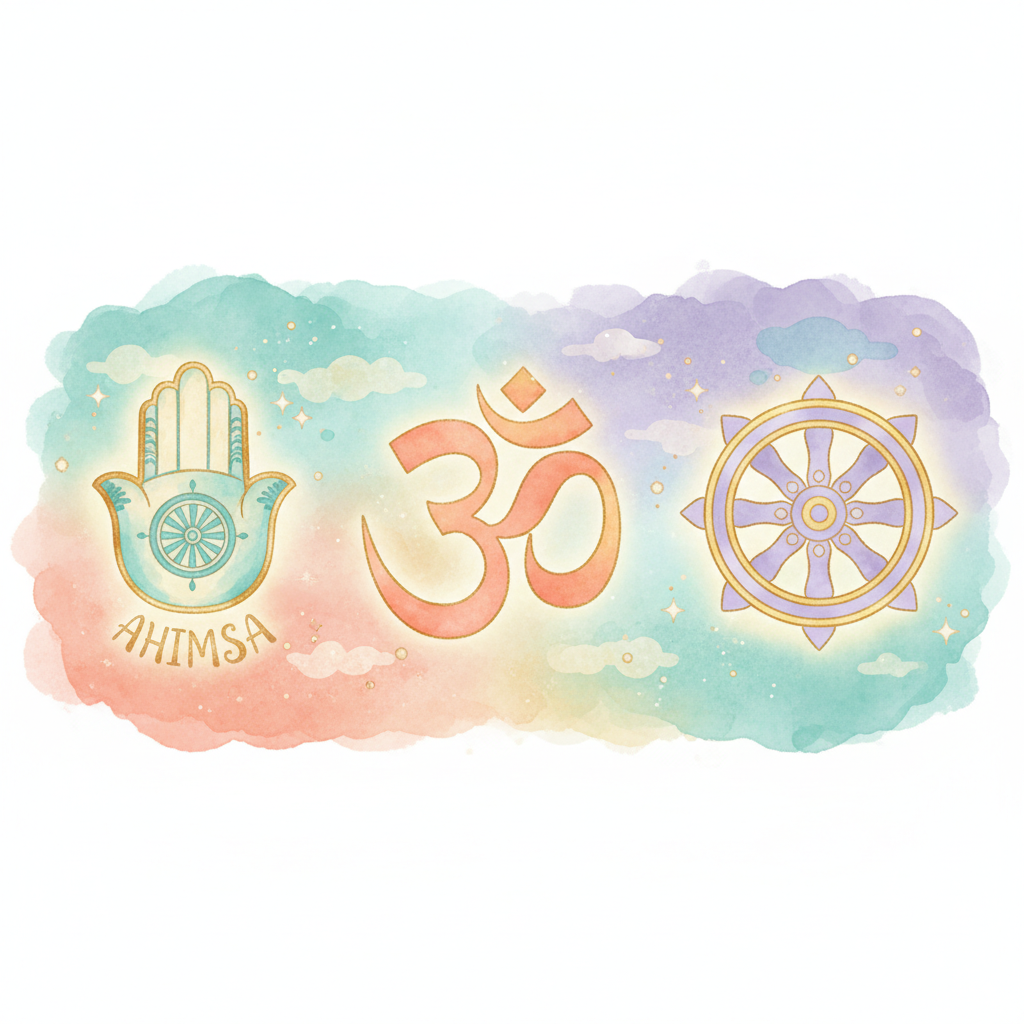
1. The Jain Ahimsa Hand: Your Superpower of Kindness You might have seen this symbol on our stickers and pins! It’s an open hand with a wheel in the center and a word right in the middle. This is the Ahimsa Hand, and it’s a reminder of one of the most beautiful powers we all have.
For Kids: Think of the open hand like a "stop" sign. It's stopping to remind us not to harm any living thing—not with our actions, our words, or even our thoughts. It’s a sign of being fearless and peaceful. The wheel in the palm is like the circle of life, reminding us that we should live in a way that is gentle to all. And the word inside? That’s Ahimsa (pronounced uh-HIM-saa). It’s the magic word for “non-harm” or “kindness.” The Ahimsa Hand is a high-five to the whole world, promising to be a kind and gentle friend to every being, from the tiniest ant to the biggest elephant.
For Parents: The Ahimsa Hand is a profound symbol in Jainism, embodying its core tenet. The open hand symbolizes the vow of Ahimsa, taken by Jain ascetics and laypeople alike, representing fearlessness and protection for all beings. The wheel in the center is the Dharmachakra, representing the resolve to halt the cycle of birth, death, and suffering (saṃsāra) through the relentless pursuit of truth and non-violence. The 24 spokes represent the teachings of the 24 Tirthankaras (spiritual teachers). It is a powerful, constant reminder that the path to spiritual liberation is paved with compassion for all life.
2. The Hindu Om (or Aum): The Sound of the Whole Universe This beautiful, curvy symbol is called Om (or Aum). It’s more than just a picture; it’s a sound! It is said to be the first sound ever made—the sound that created the universe itself.
For Kids: Imagine the gentle hum of a bumblebee or the quiet rumble of the world when you are very still. Om is like that. It’s the sound of everything, all at once. When you chant “O-m-m-m,” you can feel a little vibration inside your chest. It’s a way of connecting your own tiny hum to the giant hum of the universe. It’s a sound that reminds us that we are all part of one big, cosmic family.
For Parents: Om is a sacred syllable and one of the most important symbols in Hinduism. The visual form itself is rich with meaning. The three main curves represent the three states of consciousness: the waking state, the dream state, and the deep sleep state. The dot at the top signifies the fourth state, Turiya—a state of pure consciousness or ultimate reality that is beyond the other three. The semi-circle below the dot represents Maya, the illusion that prevents us from reaching this highest state. Chanting Om is believed to help center the mind, body, and spirit, creating a connection to the divine vibration that underlies all of existence.
3. The Buddhist Dharma Wheel: A Guide to a Happy Path This symbol looks like a beautiful old ship's steering wheel, and in a way, it is! This is the Dharma Wheel, or Dharmachakra, and it helps guide us on the path to peace and happiness.
For Kids: Imagine you’re the captain of your own ship, sailing on the sea of life. The Dharma Wheel is your special steering wheel that helps you avoid bumpy waves and find a calm, sunny spot. It usually has eight spokes. Think of them as eight secret rules for being a good captain, like “Think Kind Thoughts,” “Speak Kind Words,” and “Do Kind Things.” By following these rules, you steer yourself towards becoming a wiser and more compassionate person.
For Parents: The Dharmachakra is a central symbol in Buddhism, representing the teachings of the Buddha himself. It is said that the Buddha “turned the wheel of the dharma” when he delivered his first sermon after attaining enlightenment. The eight spokes symbolize the Noble Eightfold Path, the practical guide to ending suffering and achieving Nirvana. The circular shape of the wheel represents the perfection and completeness of the Buddha's teachings (the Dharma). The hub represents moral discipline, the spokes represent wisdom, and the rim represents the concentration that holds everything together. It is a beautiful representation of the journey and the destination, all in one.
From a hand that promises kindness to a sound that connects the universe, these symbols are so much more than drawings. They are maps, reminders, and stories. They teach us that no matter what we believe, the paths of kindness, connection, and wisdom are open to us all.
Frequently Asked Questions
Why should children learn about multiple symbols?
Learning about different symbols promotes empathy and respect for other ways of life. It shows that peace and kindness are values shared by many.
What does the Om symbol mean?
Om is a sound that represents the vibration of the whole universe. It teaches children about the interconnectedness of all living things.
How can I explain the Ahimsa hand?
It is a sign for peace and non-violence. It reminds children that choosing gentle words and actions is a sign of true strength.
Bring the Story Home
Story-inspired gifts and decor your child will love.